I don't normally post blogs on a single destination, but this movie set for scenes from The Hobbit and Lord of the Rings (LOTR) was among my top priorities for this trip (see a film clip
here from LOTR of its first appearance). As a short person with hairy feet (yes, the truth comes out), I have always identified with halflings. For the past ten days, our friends Michael and Lyna (from Fran's California days) joined us for our exploration of the North Island, including Hobbiton, the Movie Set. We were grateful for the gorgeous weather that has graced our entire trip.
 |
| The mill and stone bridge that can be seen in the movie |
 |
| The big fans, in front of Bag End, Bilbo's house |
Even if you are not a fan of the
J.R. Tolkien books or
Peter Jackson's work, you might just appreciate the design, attention to detail and adorable whimsy of this 5.5 hectare (14 acre) creation.
The scale is awe inspiring: 44 hobbit holes, at various scales so as to make the actors either look small or big. We had opted to begin with the "Shire's feast" (a delicious buffet lunch), followed by the tour of Hobbiton. It is so big that you must travel with a tour guide, and even then she said that people get lost.
 |
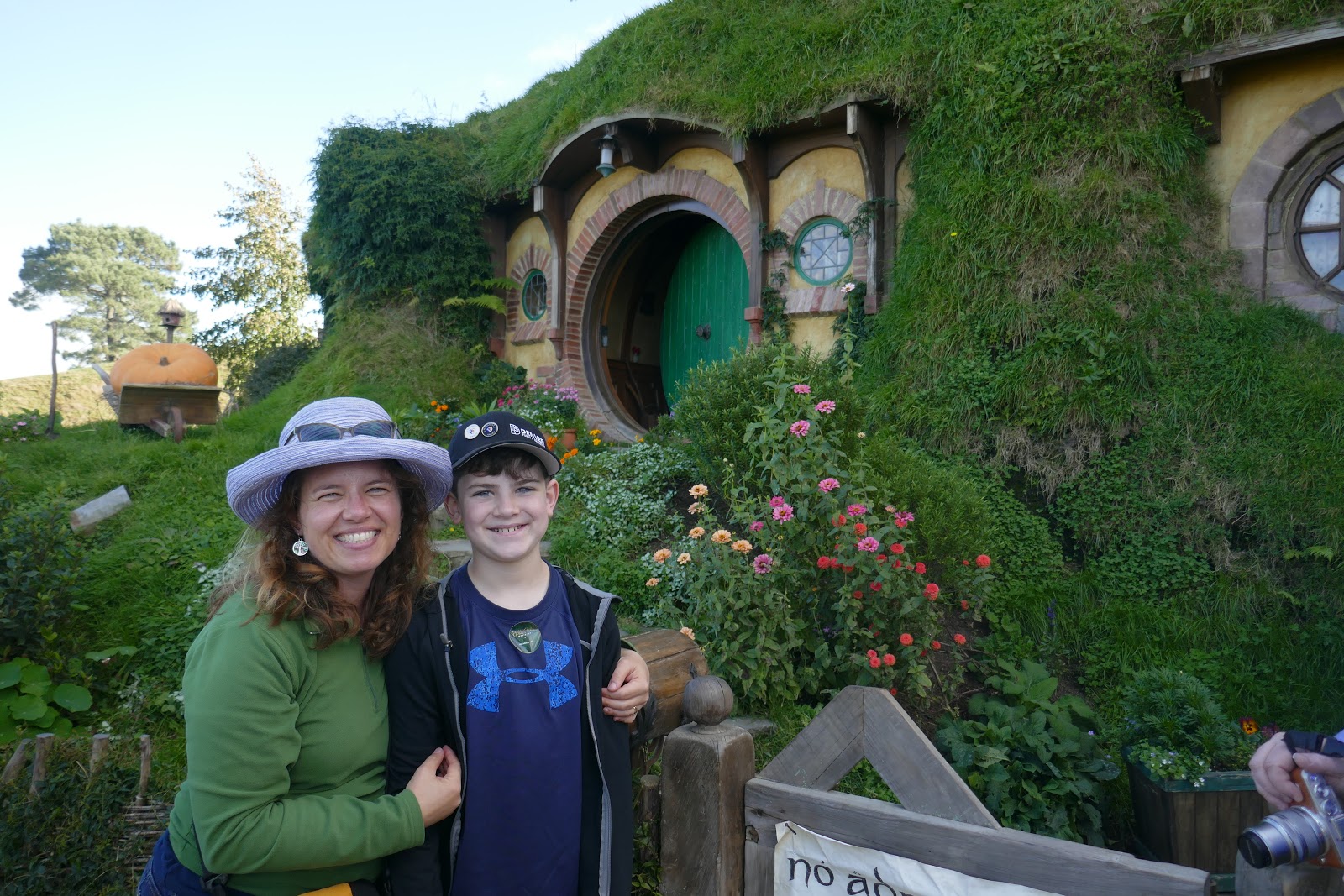
| Our gang, including "Uncle" Michael and "Auntie" Lyna, visiting from the States. We are coming out of one of the Gamgee doors. |
The tour was full of wonderful stories about the selection of that particular sheep farm (because it had a large tree by a pond and no evidence of other human habitation), and the creation of some of the scenes. It now takes a grounds staff of two dozen hard working people to maintain the site for tourists, including gorgeous plantings, all real (except for one detail, see below).
One of my favorite stories was the filming of
the touching very last scene of the LOTR's trilogy, which takes place in The Shire. In it
Sean Astin, the actor who played Sam Gamgee, Frodo's loyal companion, is "coming home" to a wife and two small children. This is presumably a few years after the big return, to show that he finally had the guts to ask his crush of many years to marry, and we can see in everyone's faces how grateful they are to be together, even the four-ish year old daughter. The actress who plays his wife actually had a baby, so that part was easy. For the older child who was to run to him, they decided to use Astin's actual daughter, which was kept as a surprise from him. He had not seen her in months because of the filming schedule, so the joy in seeing her is real, as is his interest in the new baby of his acting companion. They only needed one take (
it's worth watching again with this in mind).
 |
| Bag End, Bilbo Baggin's house, with the sign featured at the beginning of the Lord of the Rings series. Note the realistic but fake tree above. |
Another interesting fact was that the oak tree above Bilbo's house is completely realistic... and completely fake. This was because they filmed The Hobbit
after The LOTR, which is the wrong order chronologically. Thus, they had to replace a real tree with a younger, smaller version for the second trilogy. I hate that they cut down a majestic old oak but had to marvel at the artistry of its replacement.
The detail of the set was staggering- each hobbit hole was distinct and identifiable by hundreds of tiny props: the small bee-boxes and jars of honey, the doll-size ceramic mugs, the real leather saddle fit for a hobbit, and on and on.
 |
| Jeremy at the cheesemakers house |
 |
| Notice the tiny chess set! |
In fact, the miniaturization was a large part of the appeal, reminding me of my doll-house days. I delighted in every detail. But this was nothing compared to Jeremy's excitement. He said, "I never thought I would get to see this in my lifetime!"
 |
| Perhaps the town drunk's house, the carpenter's or both. See the tiny tools! |
 |
| Jeremy in front of the Green Dragon Inn, in heaven. |
The final stop of the tour was the Green Dragon Inn, where we were treated to ale in ceramic mugs; we all passed on the beer, I had the hard cider, and most others had the ginger beer, all delicious.
 |
| At the Green Dragon Inn, behind the bar |
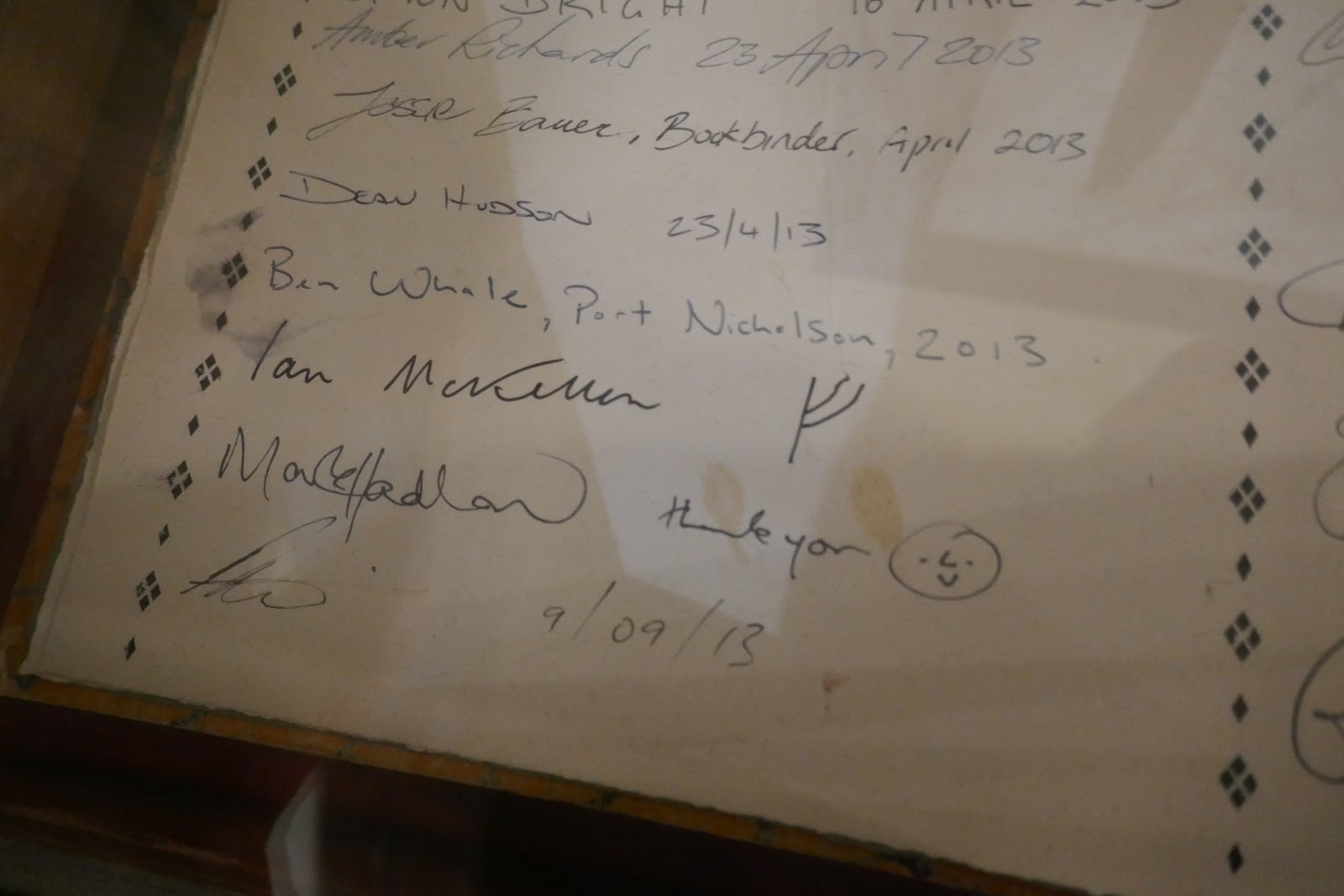
The Inn also features a guest book with plenty of recognizable names!
Legolas!
Gandolf!
In all, it really was a dream come true, at least for Jeremy and me.